


Page 20 - IMDR Journal 2025
P. 20
Research Article
            manufacturing  (automotive,  metals  and  mining),   Financial Performance Analysis with Graphs
            technology-centric  fields  (IT  and  electronics),  and   The  following  graphs  illustrate  the  revenue  growth  and
            consumer-oriented sectors (food and beverages, paints and   profit after tax for the ten selected companies before and
            coatings).
                                                              after adopting Industry 4.0 technologies.
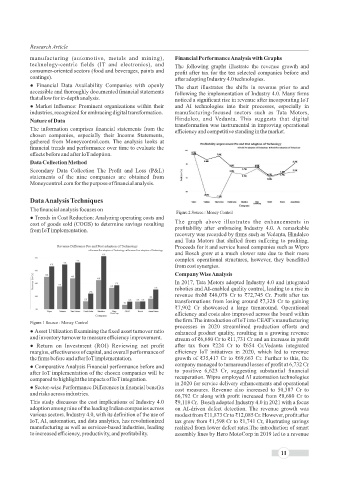
            ●  Financial  Data  Availability  Companies  with  openly   The  chart  illustrates  the  shifts  in  revenue  prior  to  and
            accessible and thoroughly documented financial statements   following the implementation of Industry 4.0. Many firms
            that allow for in-depth analysis.                 noticed a significant rise in revenue after incorporating IoT
            ● Market Influence: Prominent organizations within their   and  AI  technologies  into  their  processes,  especially  in
            industries, recognized for embracing digital transformation.  manufacturing-focused  sectors  such  as  Tata  Motors,
            Nature of Data                                    Hindalco,  and  Vedanta.  This  suggests  that  digital
                                                              transformation was instrumental in improving operational
            The information comprises financial statements from the   efficiency and competitive standing in the market.
            chosen  companies,  especially  their  Income  Statements,
            gathered  from  Moneycontrol.com.  The  analysis  looks  at
            financial trends and performance over time to evaluate the
            effects before and after IoT adoption.
            Data Collection Method
            Secondary  Data  Collection  The  Profit  and  Loss  (P&L)
            statements  of  the  nine  companies  are  obtained  from
            Moneycontrol.com for the purpose of financial analysis.

            Data Analysis Techniques

            The financial analysis focuses on
                                                               Figure 2 Source : Money Control
            ● Trends in Cost Reduction: Analyzing operating costs and
            cost of goods sold (COGS) to determine savings resulting   The  graph  above  illustrates  the  enhancements  in
            from IoT implementation.                          profitability  after  embracing  Industry  4.0.  A  remarkable
                                                              recovery was recorded by firms such as Vedanta, Hindalco
                                                              and Tata  Motors  that  shifted  from  suffering  to  profiting.
                                                              Proceeds for it and service based companies such as Wipro
                                                              and Bosch grew at a much slower rate due to their more
                                                              complex  operational  structures,  however,  they  benefitted
                                                              from cost synergies.
                                                              Company Wise Analysis
                                                              In 2017, Tata Motors adopted Industry 4.0 and integrated
                                                              robotics and AI-enabled quality control, leading to a rise in
                                                              revenue froM ₹48,078 Cr to ₹72,745 Cr. Profit after tax
                                                              transformations from losing around ₹7,328 Cr to gaining
                                                              ₹7,902  Cr  showcased  a  large  turnaround.  Operational
                                                              efficiency and costs also improved across the board within
                                                              the firm.The introduction of IoT into CEAT’s manufacturing
            Figure 1 Source : Money Control
                                                              processes  in  2020  streamlined  production  efforts  and
            ● Asset Utilization Examining the fixed asset turnover ratio   enhanced product quality, resulting in a growing revenue
            and inventory turnover to measure efficiency improvement.  stream of ₹6,680 Cr to ₹11,731 Cr and an increase in profit
            ●  Return  on  Investment  (ROI)  Reviewing  net  profit   after  tax  from  ₹224  Cr  to  ₹654  Cr.Vedanta  integrated
            margins, effectiveness of capital, and overall performance of   efficiency  IoT  initiatives  in  2020,  which  led  to  revenue
            the firms before and after IoT implementation.     growth of ₹35,417 Cr to ₹69,663 Cr. Further to this, the
                                                              company managed to turnaround losses of profit at 6,732 Cr
            ● Comparative Analysis Financial performance before and
            after IoT implementation of the chosen companies will be   to  positive  6,623  Cr,  suggesting  substantial  financial
            compared to highlight the impacts of IoT integration.  recuperation. Wipro employed AI automation technologies
                                                              in 2020 for service delivery enhancements and operational
            ● Sector-wise Performance Differences in financial benefits
                                                              cost  measures.  Revenue  also  increased  to  50,387  Cr  to
            and risks across industries.
                                                              66,792 Cr along with profit increased from ₹8,680 Cr to
            This study discusses the cost implications of Industry 4.0   ₹9,118 Cr.  Bosch adopted Industry 4.0 in 2021 with a focus
            adoption among nine of the leading Indian companies across   on  AI-driven  defect  detection.  The  revenue  growth  was
            various sectors. Industry 4.0, with its definition of the use of   modest from ₹11,873 Cr to ₹12,085 Cr. However, profit after
            IoT, AI, automation, and data analytics, has revolutionized   tax grew from ₹1,598 Cr to ₹1,741 Cr, illustrating savings
            manufacturing as well as services-based industries, leading   realized from lower defect rates.The introduction of smart
            to increased efficiency, productivity, and profitability.  assembly lines by Hero MotoCorp in 2019 led to a revenue


                                                                                                    11

