


Page 64 - IMDR Journal 2025
P. 64
Research Article
            -  Hydroponic  agriculture  hinges  on  precise  water  and   of the available studies.
            nutrient  delivery  mechanisms.  Research  posits  that  IoT-  RESEARCH METHODOLOGY
            enabled  hydroponic  systems  enhance  water  efficiency
            through  real-time  monitoring  of  pH  levels,  nutrient   This study adopts a review-based methodology, delving into
            concentrations, and temperatures.                 existing  literature  to  evaluate  sustainable  IoT  irrigation
                                                              solutions. A comparative quantitative approach is employed
            - Studies also reveal that automated hydroponic irrigation
            systems curtail water consumption while amplifying crop   to assess the efficacy of various technologies based on key
            yields.                                           factors  such  as  water  savings  percentage,  energy
                                                              consumption,  cost  efficiency,  adaptability  to  climate
            9. Smart Water Management Using LoRaWAN by Silva,   variations, and maintenance requirements.
            C., & Rodriguez, P. (2019)
                                                              Data Collection Process
            -  Research  underscores  the  efficacy  of  LoRaWAN
            technology  in  large-scale  agricultural  contexts,  enabling   The  data  collection  process  involves  selecting  peer-
            efficient  water  management  through  extended-range   reviewed  articles,  journals,  and  case  studies  published
            communication.                                    within the last five years. A comparative analysis is then
                                                              conducted  to  compare  efficiency  metrics  reported  in
            -  Studies  demonstrate  that  LoRaWAN-based  irrigation   different  IoT-based  irrigation  technologies.  Common
            systems  ensure  dependable  data  transmission  even  in   trends, advantages, and limitations identified across studies
            secluded  agricultural  fields,  thereby  reducing  water   are carefully examined.
            wastage.
                                                              Review of Existing Literature
            10. Edge Computing in IoT-Based Irrigation by Sharma,
            V., & Bansal, P. (2021)                           The literature review highlights the positive impact of IoT-
                                                              based  irrigation  in  reducing  water  consumption  and
            -  Edge  computing  is  being  explored  to  augment  the   enhancing crop yield. Cloud-based platforms enable remote
            efficiency of IoT irrigation systems. Studies propose that   monitoring, while AI-driven automation enhances precision
            processing data at the edge (in close proximity to sensors)   in irrigation practices. However, concerns regarding data
            curtails latency and diminishes reliance on cloud servers.  security,  network  reliability,  and  affordability  remain
            - Research findings show that using edge-based solutions   significant  areas  of  focus  for  future  research  and
            helps improve response times and makes the network more   development efforts.
            reliable. This, in turn, makes irrigation automation work   Quantitative Research
            more effectively and efficiently.
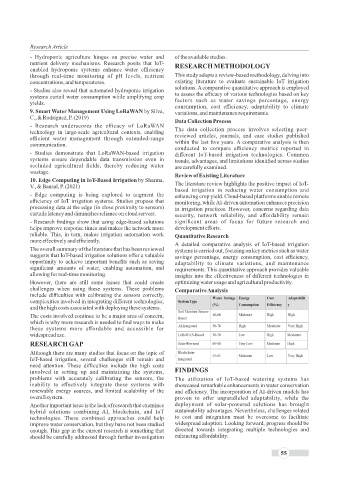
                                                              A  detailed  comparative  analysis  of  IoT-based  irrigation
            The overall summary of the literature that has been reviewed   systems is carried out, focusing on key metrics such as water
            suggests that IoT-based irrigation solutions offer a valuable   savings  percentage,  energy  consumption,  cost  efficiency,
            opportunity to achieve important benefits such as saving   adaptability  to  climate  variations,  and  maintenance
            significant  amounts  of  water,  enabling  automation,  and   requirements. This quantitative approach provides valuable
            allowing for real-time monitoring.                insights into the effectiveness of different technologies in
            However,  there  are  still  some  issues  that  could  create   optimizing water usage and agricultural productivity.
            challenges  when  using  these  systems.  These  problems   Comparative Analysis
            include difficulties with calibrating the sensors correctly,
            complexities involved in integrating different technologies,
            and the high costs associated with deploying these systems.
            The costs involved continue to be a major area of concern,
            which is why more research is needed to find ways to make
            these  systems  more  affordable  and  accessible  for
            widespread use.
            RESEARCH GAP
            Although there are many studies that focus on the topic of
            IoT-based  irrigation,  several  challenges  still  remain  and
            need  attention.  These  difficulties  include  the  high  costs
            involved  in  setting  up  and  maintaining  the  systems,   FINDINGS
            problems  with  accurately  calibrating  the  sensors,  the   The  utilization  of  IoT-based  watering  systems  has
            inability  to  effectively  integrate  these  systems  with   showcased remarkable enhancements in water conservation
            renewable  energy  sources,  and  limited  scalability  of  the   and efficiency. The incorporation of AI-driven models has
            overall system.                                   proven  to  offer  unparalleled  adaptability,  while  the
            Another important issue is the lack of research that examines   deployment  of  solar-powered  solutions  has  brought
            hybrid  solutions  combining  AI,  blockchain,  and  IoT   sustainability advantages. Nevertheless, challenges related
            technologies.  These  combined  approaches  could  help   to  cost  and  integration  must  be  overcome  to  facilitate
            improve water conservation, but they have not been studied   widespread adoption. Looking forward, progress should be
            enough. This gap in the current research is something that   directed  towards  integrating  multiple  technologies  and
            should be carefully addressed through further investigation   enhancing affordability.


                                                                                                    55

