


Page 39 - IMDR Journal 2025
P. 39
Research Article
            OBJECTIVES                                        (Source: Market Research Future (2023).
            ● To see how deep tech helps countries gain power.  “Deep  Tech  Market  Trends  and  Forecast  2023-2030."
                                                              www.marketresearchfuture.com )
            ● To study what the U.S., China, EU, and India are doing to
            lead in tech.                                     The competition for deep tech dominance is closely linked
                                                              to  national  security  concerns,  economic  strategies,  and
            ● To understand how trade rules and copyright laws affect   geopolitical influence. A study by Kissinger et al. (2021)
            progress.
                                                              underscores the role of AI and emerging technologies in
            ● To look at issues like cybersecurity and privacy in deep   reshaping military capabilities and governance structures,
            tech.                                             fueling tensions between technological superpowers. The
            ● To offer ideas on how countries can balance growth and   ongoing  U.S.-China  technology  rivalry  exemplifies  this,
            safety.                                           with trade restrictions, intellectual property disputes, and
                                                              efforts to secure critical supply chains dominating policy
                                                              agendas. According to McKinsey Global Institute (2022),
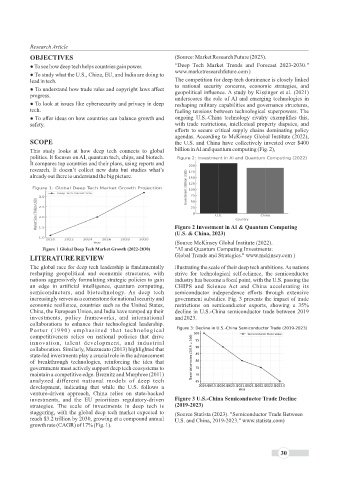
            SCOPE                                             the U.S. and China have collectively invested over $400
            This  study  looks  at  how  deep  tech  connects  to  global   billion in AI and quantum computing (Fig. 2),
            politics. It focuses on AI, quantum tech, chips, and biotech.
            It compares top countries and their plans, using reports and
            research.  It  doesn’t  collect  new  data  but  studies  what’s
            already out there to understand the big picture.


                                                              Figure 2 Investment in AI & Quantum Computing
                                                              (U.S. & China, 2023)
                                                              (Source McKinsey Global Institute (2022).
                Figure 1 Global Deep Tech Market Growth (2022-2030)  "AI and Quantum Computing Investments:
                                                              Global Trends and Strategies." www.mckinsey.com )
            LITERATURE REVIEW
            The global race for deep tech leadership is fundamentally   illustrating the scale of their deep tech ambitions. As nations
            reshaping  geopolitical  and  economic  structures,  with   strive  for  technological  self-reliance,  the  semiconductor
            nations aggressively formulating strategic policies to gain   industry has become a focal point, with the U.S. passing the
            an  edge  in  artificial  intelligence,  quantum  computing,   CHIPS  and  Science  Act  and  China  accelerating  its
            semiconductors,  and  biotechnology.  As  deep  tech   semiconductor  independence  efforts  through  extensive
            increasingly serves as a cornerstone for national security and   government subsidies. Fig. 3 presents the impact of trade
            economic resilience, countries such as the United States,   restrictions  on  semiconductor  exports,  showing  a  35%
            China, the European Union, and India have ramped up their   decline in U.S.-China semiconductor trade between 2019
            investments,  policy  frameworks,  and  international   and 2023.
            collaborations  to  enhance  their  technological  leadership.
            Porter  (1990)  emphasized  that  technological
            competitiveness  relies  on  national  policies  that  drive
            innovation,  talent  development,  and  industrial
            collaboration. Similarly, Mazzucato (2013) highlighted that
            state-led investments play a crucial role in the advancement
            of  breakthrough  technologies,  reinforcing  the  idea  that
            governments must actively support deep tech ecosystems to
            maintain a competitive edge. Breznitz and Murphree (2011)
            analyzed  different  national  models  of  deep  tech
            development,  indicating  that  while  the  U.S.  follows  a
            venture-driven  approach,  China  relies  on  state-backed
            investments,  and  the  EU  prioritizes  regulatory-driven   Figure 3 U.S.-China Semiconductor Trade Decline
            strategies.  The  scale  of  investments  in  deep  tech  is   (2019-2023)
            staggering, with the global deep tech market expected to   (Source Statista (2023). "Semiconductor Trade Between
            reach $3.2 trillion by 2030, growing at a compound annual   U.S. and China, 2019-2023." www.statista.com)
            growth rate (CAGR) of 17% (Fig. 1).


                                                                                                    30

