


Page 40 - IMDR Journal 2025
P. 40
Research Article
             Moreover, Japan, South Korea, and the European Union are   Cybersecurity threats are also becoming more prominent as
            increasing  their  semiconductor  production  capacity  to   deep tech innovations increase the risk of cyber warfare and
            reduce dependency on external sources, further intensifying   data  breaches,  making  international  cooperation  on
            competition in the global technology race.        cybersecurity  policies  essential  for  mitigating  potential
            Despite  the  strategic  importance  of  deep  tech,  several   threats.
            challenges persist, including talent shortages, cybersecurity   The role of deep tech startups has also become a crucial
            risks,  and  regulatory  complexities. The World  Economic   factor in global competition, with venture capital funding
            Forum (2023) highlighted that a global shortage of skilled   for deep tech startups reaching $62 billion in 2023, a 30%
            professionals in AI, quantum computing, and biotech poses   increase from the previous year (Fig. 6).
            a  major  bottleneck  for  deep  tech  growth,  with  nations
            competing  to  attract  and  retain  top-tier  researchers  and
            engineers. The Global Talent Competitiveness Index (2023)
            reports that the U.S. and China lead in AI talent acquisition,
            with  over  60%  of  the  world’s  top  AI  researchers
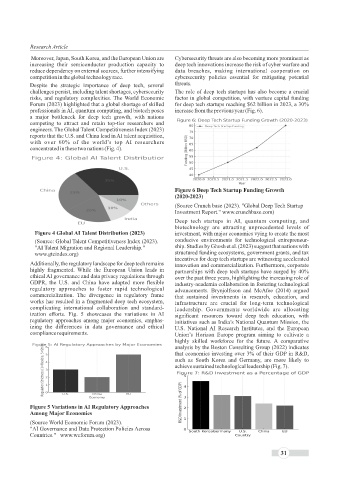
            concentrated in these two nations (Fig. 4).


                                                              Figure 6 Deep Tech Startup Funding Growth
                                                              (2020-2023)
                                                              (Source Crunch base (2023). "Global Deep Tech Startup
                                                              Investment Report." www.crunchbase.com)
                                                              Deep  tech  startups  in  AI,  quantum  computing,  and
                                                              biotechnology  are  attracting  unprecedented  levels  of
             Figure 4 Global AI Talent Distribution (2023)    investment, with major economies vying to create the most
             (Source: Global Talent Competitiveness Index (2023).   conducive  environments  for  technological  entrepreneur-
             "AI Talent Migration and Regional Leadership."   ship. Studies by Ghosh et al. (2023) suggest that nations with
             www.gtcindex.org)                                structured funding ecosystems, government grants, and tax
                                                              incentives for deep tech startups are witnessing accelerated
            Additionally, the regulatory landscape for deep tech remains   innovation and commercialization. Furthermore, corporate
            highly  fragmented.  While  the  European  Union  leads  in   partnerships with deep tech startups have surged by 40%
            ethical AI governance and data privacy regulations through   over the past three years, highlighting the increasing role of
            GDPR,  the  U.S.  and  China  have  adopted  more  flexible   industry-academia collaboration in fostering technological
            regulatory  approaches  to  foster  rapid  technological   advancements.  Brynjolfsson  and  McAfee  (2014)  argued
            commercialization.  The  divergence  in  regulatory  frame   that  sustained  investments  in  research,  education,  and
            works has resulted in a fragmented deep tech ecosystem,   infrastructure  are  crucial  for  long-term  technological
            complicating  international  collaboration  and  standard-  leadership.  Governments  worldwide  are  allocating
            ization  efforts.  Fig.  5  showcases  the  variations  in  AI   significant  resources  toward  deep  tech  education,  with
            regulatory approaches among major economies, emphas-  initiatives such as India’s National Quantum Mission, the
            izing  the  differences  in  data  governance  and  ethical   U.S.  National  AI  Research  Institutes,  and  the  European
            compliance requirements.                          Union’s  Horizon  Europe  program  aiming  to  cultivate  a
                                                              highly  skilled  workforce  for  the  future.  A  comparative
                                                              analysis by the Boston Consulting Group (2022) indicates
                                                              that economies investing over 3% of their GDP in R&D,
                                                              such  as  South  Korea  and  Germany,  are  more  likely  to
                                                              achieve sustained technological leadership (Fig. 7).


            Figure 5 Variations in AI Regulatory Approaches
            Among Major Economies
            (Source World Economic Forum (2023).
            "AI Governance and Data Protection Policies Across
            Countries."   www.weforum.org)


                                                                                                    31

