


Page 54 - IMDR Journal 2025
P. 54
Research Article
            swimming aids has helped in various technologies to help   ● Judo
            visually impaired individuals. These aids primarily utilize   According to  Moein, S., Movahedi, M., & Ghasemzadeh,
            sensors and wearable devices to make swimmers free to   H. (2022) Eye-tracking devices are used to monitor where
            swim  in  their  environment  Hartono,  F.,  Tangkudung,  J.,
                                                              and how athletes focus their visual attention during a match.
            Sukur, A., & Dlis, F. (2020) According to this paper the 3
                                                              This helps researchers to understand the role of visual cues
            types  of  sensors  and  its  utilization  are  mentioned  in  the   in Judo techniques and strategies.Other such technology is
            below image -                                     Motion  capture  system  which  record  and  analyze  the
                                                              athlete's  body  movements  to  assess  coordination  and
                                                              positioning during a match. It allows researchers to explore
                                                              how athletes struggle for a lack of sight or rely on other
                                                              senses  to  perform  effectively.Jara,  A.,  &  Cifuentes,  C.
                                                              (2021)
                                                              According to Yuan, X., Cui, G., & Zhang, J. (2022) VR
                                                              technology could be used to simulate training environments
                                                              where athletes practice Judo without sight. This helps in
                                                              studying how athletes adapt to fighting without visual input
                                                              and  rely  more  on  other  sensory  cues  such  as  touch  or
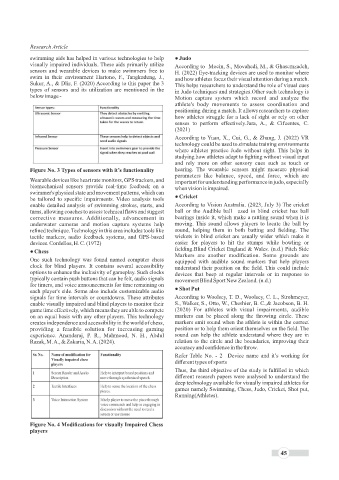
            Figure No. 3 Types of sensors with it’s functionality   hearing.  The  wearable  sensors  might  measure  physical
                                                              parameters  like  balance,  speed,  and  force,  which  are
            Wearable devices like heart rate monitors, GPS trackers, and   important for understanding performance in judo, especially
            biomechanical  sensors  provide  real-time  feedback  on  a   when vision is impaired.
            swimmer's physical state and movement patterns, which can
            be  tailored  to  specific  impairments. Video  analysis  tools   ● Cricket
            enable detailed analysis of swimming strokes, starts, and   According to Vision Australia. (2023, July 3) The cricket
            turns, allowing coaches to assess technical flaws and suggest   ball  or  the Audible  ball    used  in  blind  cricket  has  ball
            corrective  measures.  Additionally,  advancement  in   bearings inside it, which make a rattling sound when it is
            underwater  cameras  and  motion  capture  systems  help   moving. This  sound  allows  players  to  locate  the  ball  by
            refined technique. Technology in this area includes tools like   sound,  helping  them  in  both  batting  and  fielding.  The
            tactile  markers,  audio  feedback  systems,  and  GPS-based   wickets in blind cricket are usually wider which make it
            devices. Cordellos, H. C. (1972)                  easier  for  players  to  hit  the  stumps  while  bowling  or
                                                              fielding.Blind Cricket England & Wales. (n.d.) Pitch Side
            ● Chess
                                                              Markers  are  another  modification.  Some  grounds  are
            One  such  technology  was  found  named  computer  chess
                                                              equipped  with  audible  sound  markers  that  help  players
            clock  for  blind  players.  It  contains  several  accessibility
                                                              understand their position on the field. This could include
            options to enhance the inclusivity of gameplay. Such clocks   devices  that  beep  at  regular  intervals  or  in  response  to
            typically contain push buttons that can be felt, audio signals   movement Blind Sport New Zealand. (n.d.)
            for timers, and voice announcements for time remaining on
            each player's side. Some also include customizable audio   ● Shot Put
            signals for time intervals or countdowns. These attributes   According to Woolsey, T. D., Woolsey, C. L., Strohmeyer,
            enable visually impaired and blind players to monitor their   S., Walker, S., Otto, W., Cheshier, B. C.,& Jacobson, B. H.
            game time effectively, which means they are able to compete   (2020)  For  athletes  with  visual  impairments,  audible
            on an equal basis with any other players. This technology   markers  can  be  placed  along  the  throwing  circle.  These
            creates independence and accessibility in the world of chess,   markers emit sound when the athlete is within the correct
            providing  a  feasible  solution  for  increasing  gaming   position or to help them orient themselves on the field. The
            experience.  Anandaraj,  P.  R.,  Mahmood,  N.  H.,  Abdul   sound can help the athlete understand where they are in
            Razak, M. A., & Zakaria, N. A. (2024).            relation to the circle and the boundaries, improving their
                                                              accuracy and confidence in the throw.
                                                              Refer Table  No.  -  2    Device  name  and  it’s  working  for
                                                              different types of sports
                                                              Thus, the third objective of the study is fulfilled in which
                                                              different research papers were analysed to understand the
                                                              deep technology available for visually impaired athletes for
                                                              games namely Swimming, Chess, Judo, Cricket, Shot put,
                                                              Running(Athletes).


            Figure No. 4 Modifications for visually Impaired Chess
            players


                                                                                                    45

