


Page 70 - IMDR Journal 2025
P. 70
Research Article
            practices for improving transparency and trust in AI-driven   1. Convenience Sampling Bias
            systems.                                          The use of convenience sampling may introduce bias, as
            Sampling Framework                                respondents may not fully represent the broader population
            Sample  Frame  The  study  targets  health  insurance   of  policyholders.  For  example,  urban  respondents  are
            policyholders in Pune, India, who have recently filed claims.   overrepresented  in  the  sample,  which  may  limit  the
            Pune is chosen as the study location due to its mix of urban   generalizability of findings to rural areas.
            and  semi-urban  populations,  making  it  representative  of   2. Self-Reported Biases
            India's diverse insurance market. Respondents are selected   Survey  responses  are  based  on  self-reported  data,  which
            based on their experience with claims processing, ensuring   may be subject to biases such as social desirability bias or
            that they have first-hand insights into the efficiency, fairness,
                                                              recall bias. Respondents may overstate their satisfaction or
            and transparency of AI-driven systems.
                                                              underreport challenges due to perceived expectations.
            Sample  Size  A  sample  size  of  approximately  150   3. Limited Scope
            respondents is selected to ensure a balance between depth of
            analysis and feasibility. This size is sufficient to identify   The  study  focuses  on  health  insurance  policyholders  in
            trends  and  patterns  in  consumer  perceptions  while   Pune,  which  may  not  fully  capture  the  experiences  of
            remaining manageable within the study's scope. The sample   policyholders  in  other  regions  or  with  different  types  of
            size  is  determined  based  on  the  need  for  statistical   insurance.
            significance and the availability of respondents.  4. Technical Limitations
            Sampling  Technique  The  study  uses  convenience   The  study  does  not  evaluate  the  technical  aspects  of AI
            sampling, a non-probability sampling technique, to recruit   algorithms  or  their  development,  limiting  its  ability  to
            respondents.  Convenience  sampling  is  chosen  due  to  its   provide technical recommendations.
            practicality  and  ease  of  implementation,  especially  in  a
            rapidly  digitizing  market  like  India.  Online  survey  tools
            such  as  Google  Forms  and  Survey  Monkey  are  used  to   ANALYSIS & INTERPRETATION
            distribute  the  survey,  ensuring  wide  reach  and  ease  of   Survey & Interview Findings
            participation. While convenience sampling has limitations   Consumer Awareness of AI in Health Insurance
            in terms of generalizability, it is suitable for exploratory
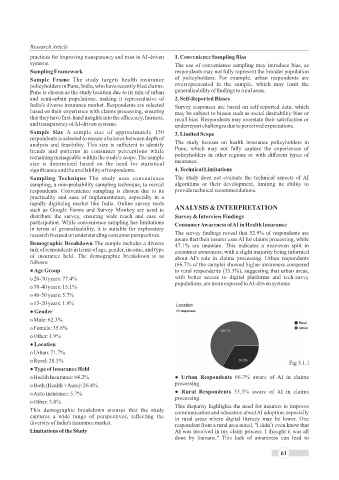
            research focused on understanding consumer perspectives.  The survey findings reveal that 52.9% of respondents are
                                                              aware that their insurer uses AI for claims processing, while
            Demographic Breakdown The sample includes a diverse   47.1%  are  unaware.  This  indicates  a  near-even  split  in
            mix of respondents in terms of age, gender, income, and type   consumer awareness, with a slight majority being informed
            of  insurance  held.  The  demographic  breakdown  is  as   about AI's  role  in  claims  processing.  Urban  respondents
            follows:
                                                              (66.7% of the sample) showed higher awareness compared
            ● Age Group                                       to rural respondents (33.3%), suggesting that urban areas,
            o 20-30 years: 77.4%                              with  better  access  to  digital  platforms  and  tech-savvy
                                                              populations, are more exposed to AI-driven systems.
            o 30-40 years: 15.1%
            o 40-50 years: 5.7%
            o 15-20 years: 1.9%
            ● Gender
            o Male: 62.3%
            o Female: 35.8%
            o Other: 1.9%
            ● Location
            o Urban: 71.7%
            o Rural: 28.3%                                                                             Fig 5.1.1
            ● Type of Insurance Held
            o Health Insurance: 64.2%                         ●  Urban  Respondents  66.7%  aware  of  AI  in  claims
            o Both (Health + Auto): 26.4%                     processing.
            o Auto Insurance: 5.7%                            ●  Rural  Respondents  33.3%  aware  of  AI  in  claims
                                                              processing.
            o Other: 3.8%
                                                              This disparity highlights the need for insurers to improve
            This  demographic  breakdown  ensures  that  the  study   communication and education about AI adoption, especially
            captures  a  wide  range  of  perspectives,  reflecting  the   in  rural  areas  where  digital  literacy  may  be  lower.  One
            diversity of India's insurance market.
                                                              respondent from a rural area noted, "I didn’t even know that
            Limitations of the Study                          AI was involved in my claim process. I thought it was all
                                                              done  by  humans."  This  lack  of  awareness  can  lead  to

                                                                                                    61

