


Page 71 - IMDR Journal 2025
P. 71
Research Article
            mistrust and dissatisfaction, particularly when claims are   explanations for decisions.
            rejected without clear explanations.
                                                              Bias in Claim Decisions
            Perceived Efficiency of AI-Driven Claims Processing  Another major challenge is the perception of bias in AI-
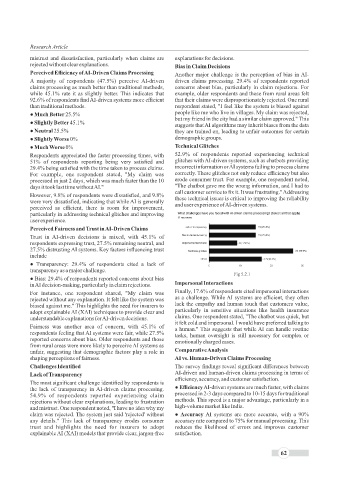
            A  majority  of  respondents  (47.5%)  perceive  AI-driven   driven claims processing. 29.4% of respondents reported
            claims processing as much better than traditional methods,   concerns about bias, particularly in claim rejections. For
            while 45.1% rate it as slightly better. This indicates that   example, older respondents and those from rural areas felt
            92.6% of respondents find AI-driven systems more efficient   that their claims were disproportionately rejected. One rural
            than traditional methods.                         respondent stated, "I feel like the system is biased against
                                                              people like me who live in villages. My claim was rejected,
            ● Much Better 25.5%
                                                              but my friend in the city had a similar claim approved." This
            ● Slightly Better 45.1%
                                                              suggests that AI algorithms may inherit biases from the data
            ● Neutral 25.5%                                   they are trained on, leading to unfair outcomes for certain
            ● Slightly Worse 0%                               demographic groups.
            ● Much Worse 0%                                   Technical Glitches
            Respondents appreciated the faster processing times, with   52.9%  of  respondents  reported  experiencing  technical
            51%  of  respondents  reporting  being  very  satisfied  and   glitches with AI-driven systems, such as chatbots providing
            29.4% being satisfied with the time taken to process claims.   incorrect information or AI systems failing to process claims
            For  example,  one  respondent  stated,  "My  claim  was   correctly. These glitches not only reduce efficiency but also
            processed in just 2 days, which was much faster than the 10   erode consumer trust. For example, one respondent noted,
            days it took last time without AI."               "The chatbot gave me the wrong information, and I had to
                                                              call customer service to fix it. It was frustrating." Addressing
            However, 9.8% of respondents were dissatisfied, and 9.8%
                                                              these technical issues is critical to improving the reliability
            were very dissatisfied, indicating that while AI is generally   and user experience of AI-driven systems.
            perceived  as  efficient,  there  is  room  for  improvement,
            particularly in addressing technical glitches and improving
            user experience.
            Perceived Fairness and Trust in AI-Driven Claims
            Trust  in  AI-driven  decisions  is  mixed,  with  45.1%  of
            respondents expressing trust, 27.5% remaining neutral, and
            27.5% distrusting AI systems. Key factors influencing trust
            include
            ●  Transparency:  29.4%  of  respondents  cited  a  lack  of
            transparency as a major challenge.
                                                                                   Fig 5.2.1
            ● Bias: 29.4% of respondents reported concerns about bias
            in AI decision-making, particularly in claim rejections.  Impersonal Interactions
            For  instance,  one  respondent  shared,  "My  claim  was   Finally, 17.6% of respondents cited impersonal interactions
            rejected without any explanation. It felt like the system was   as a challenge. While AI systems are efficient, they often
            biased against me." This highlights the need for insurers to   lack the empathy and human touch that customers value,
            adopt explainable AI (XAI) techniques to provide clear and   particularly  in  sensitive  situations  like  health  insurance
                                                              claims. One respondent stated, "The chatbot was quick, but
            understandable explanations for AI-driven decisions.
                                                              it felt cold and impersonal. I would have preferred talking to
            Fairness  was  another  area  of  concern,  with  45.1%  of   a human." This suggests that while AI can handle routine
            respondents feeling that AI systems were fair, while 27.5%   tasks,  human  oversight  is  still  necessary  for  complex  or
            reported concerns about bias. Older respondents and those   emotionally charged cases.
            from rural areas were more likely to perceive AI systems as
            unfair, suggesting that demographic factors play a role in   Comparative Analysis
            shaping perceptions of fairness.                  AI vs. Human-Driven Claims Processing
            Challenges Identified                              The survey findings reveal significant differences between
            Lack of Transparency                              AI-driven and human-driven claims processing in terms of
                                                              efficiency, accuracy, and customer satisfaction.
            The most significant challenge identified by respondents is
                                                              ● Efficiency AI-driven systems are much faster, with claims
            the  lack  of  transparency  in AI-driven  claims  processing.
                                                              processed in 2-3 days compared to 10-15 days for traditional
            54.9%  of  respondents  reported  experiencing  claim
            rejections without clear explanations, leading to frustration   methods. This speed is a major advantage, particularly in a
            and mistrust. One respondent noted, "I have no idea why my   high-volume market like India.
            claim was rejected. The system just said 'rejected' without   ● Accuracy AI  systems  are  more  accurate,  with  a  90%
            any  details."  This  lack  of  transparency  erodes  consumer   accuracy rate compared to 75% for manual processing. This
            trust  and  highlights  the  need  for  insurers  to  adopt   reduces  the  likelihood  of  errors  and  improves  customer
            explainable AI (XAI) models that provide clear, jargon-free   satisfaction.


                                                                                                    62

