


Page 72 - IMDR Journal 2025
P. 72
Research Article
            ●  Fraud  Detection  AI  systems  are  highly  effective  at
            detecting fraud, with an 85% detection rate compared to
            60%  for  traditional  methods.  This  helps  insurers  reduce
            financial losses and improve operational efficiency.
            However, AI-driven  systems  face  challenges  in  terms  of
            transparency, fairness, and customer interaction. While AI is
            efficient,  it  often  lacks  the  human  touch  that  customers
            value, particularly in sensitive situations. Additionally, the                            Fig 6.1.2
            lack of transparency in AI decision-making can erode trust,
            particularly  when  claims  are  rejected  without  clear   5. Digital Literacy Challenges
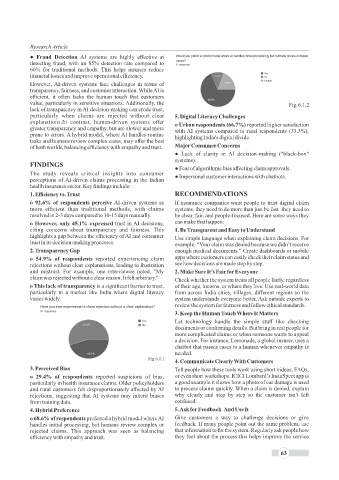
            explanations.In  contrast,  human-driven  systems  offer   o Urban respondents (66.7%) reported higher satisfaction
            greater transparency and empathy, but are slower and more   with AI systems compared to rural respondents (33.3%),
            prone to errors. A hybrid model, where AI handles routine   highlighting India's digital divide.
            tasks and humans review complex cases, may offer the best
            of both worlds, balancing efficiency with empathy and trust.  Major Consumer Concerns
                                                              ●  Lack  of  clarity  in  AI  decision-making  ("black-box"
                                                              systems).
            FINDINGS
                                                              ● Fear of algorithmic bias affecting claim approvals.
            The  study  reveals  critical  insights  into  consumer
                                                              ● Impersonal customer interactions with chatbots.
            perceptions of AI-driven claims processing in the Indian
            health insurance sector. Key findings include:
            1. Efficiency vs. Trust                             RECOMMENDATIONS
            o  92.6%  of  respondents  perceive AI-driven  systems  as   If insurance companies want people to trust digital claim
            more  efficient  than  traditional  methods,  with  claims   systems, they need to do more than just be fast  they need to
            resolved in 2-3 days compared to 10-15 days manually.  be clear, fair, and people-focused. Here are some ways they
            o However, only 45.1% expressed trust in AI decisions,   can make that happen:
            citing  concerns  about  transparency  and  fairness.  This   1. Be Transparent and Easy to Understand
            highlights a gap between the efficiency of AI and consumer   Use simple language when explaining claim decisions. For
            trust in its decision-making processes.
                                                              example: “Your claim was denied because we didn’t receive
            2. Transparency Gap                               enough medical documents.” Create dashboards or mobile
            o  54.9%  of  respondents  reported  experiencing  claim   apps where customers can easily check their claim status and
            rejections without clear explanations, leading to frustration   see how decisions are made step by step.
            and  mistrust.  For  example,  one  interviewee  noted,  "My   2. Make Sure It’s Fair for Everyone
            claim was rejected without a clear reason. It felt arbitrary."
                                                              Check whether the system treats all people fairly, regardless
            o This lack of transparency is a significant barrier to trust,   of their age, income, or where they live. Use real-world data
            particularly  in  a  market  like  India  where  digital  literacy   from across India cities, villages, different regions so the
            varies widely.                                    system understands everyone better. Ask outside experts to
                                                              review the system for fairness and follow ethical standards.
                                                              3. Keep the Human Touch Where It Matters
                                                              Let  technology  handle  the  simple  stuff  like  checking
                                                              documents or confirming details. But bring in real people for
                                                              more complicated claims or when someone wants to appeal
                                                              a decision. For instance, Lemonade, a global insurer, uses a
                                                              chatbot that passes cases to a human whenever empathy is
                                                              needed.
                                                     Fig 6.1.1
                                                              4. Communicate Clearly With Customers
            3. Perceived Bias                                 Tell people how these tools work using short videos, FAQs,
            o  29.4%  of  respondents  reported  suspicions  of  bias,   or even short workshops. ICICI Lombard’s InstaSpect app is
            particularly in health insurance claims. Older policyholders   a good example it shows how a photo of car damage is used
            and rural customers felt disproportionately affected by AI   to process claims quickly. When a claim is denied, explain
            rejections, suggesting that AI systems may inherit biases   why  clearly  and  step  by  step  so  the  customer  isn’t  left
            from training data.                               confused.
            4. Hybrid Preference                              5. Ask for Feedback  And Use It
            o 68.6% of respondents preferred a hybrid model where AI   Give  customers  a  way  to  challenge  decisions  or  give
            handles initial processing, but humans review complex or   feedback. If many people point out the same problem, use
            rejected  claims.  This  approach  was  seen  as  balancing   that information to fix the system. Regularly ask people how
            efficiency with empathy and trust.                  they feel about the process this helps improve the service


                                                                                                    63

