


Page 91 - IMDR Journal 2025
P. 91
Research Article
            precise  and  secure  with  the  help  of  technologies.  Also,
            researchers understand that the changing role of deep tech in
            trade finance. That opens a new opportunity for businesses.


            LITERATURE REVIEW
            Deep technologies have transformed global trade finance
            through major advancements during recent years. The new
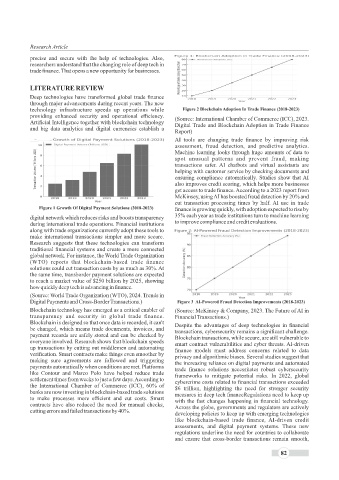
            technology  infrastructure  speeds  up  operations  while   Figure 2 Blockchain Adoption In Trade Finance (2018-2023)
            providing  enhanced  security  and  operational  efficiency.   (Source: International Chamber of Commerce (ICC), 2023.
            Artificial Intelligence together with blockchain technology   Digital Trade and Blockchain Adoption in Trade Finance
            and  big  data  analytics  and  digital  currencies  establish  a
                                                              Report)
                                                              AI  tools  are  changing  trade  finance  by  improving  risk
                                                              assessment,  fraud  detection,  and  predictive  analytics.
                                                              Machine learning looks through huge amounts of data to
                                                              spot  unusual  patterns  and  prevent  fraud,  making
                                                              transactions  safer.  AI  chatbots  and  virtual  assistants  are
                                                              helping with customer service by checking documents and
                                                              ensuring compliance automatically. Studies show that AI
                                                              also improves credit scoring, which helps more businesses
                                                              get access to trade finance. According to a 2023 report from
                                                              McKinsey, using AI has boosted fraud detection by 20% and
                                                              cut transaction processing times by half. AI use in trade
               Figure 1 Growth Of Digital Payment Solutions (2018-2023)  finance is growing quickly, with adoption expected to rise by
                                                              35% each year as trade institutions turn to machine learning
            digital network which reduces risks and boosts transparency
            during international trade operations. Financial institutions   to improve compliance and credit evaluations.
            along with trade organizations currently adopt these tools to
            make international transactions simpler and more secure.
            Research  suggests  that  these  technologies  can  transform
            traditional financial systems and create a more connected
            global network. For instance, the World Trade Organization
            (WTO)  reports  that  blockchain-based  trade  finance
            solutions could cut transaction costs by as much as 30%. At
            the same time, transborder payment solutions are expected
            to reach a market value of $250 billion by 2025, showing
            how quickly deep tech is advancing in finance.
            (Source: World Trade Organization (WTO), 2024. Trends in
            Digital Payments and Cross-Border Transactions.)   Figure 3  AI-Powered Fraud Detection Improvements (2018-2023)
            Blockchain technology has emerged as a critical enabler of   (Source: McKinsey & Company, 2023. The Future of AI in
            transparency  and  security  in  global  trade  finance.   Financial Transactions.)
            Blockchain is designed so that once data is recorded, it can't   Despite  the  advantages  of  deep  technologies  in  financial
            be changed, which means trade documents, invoices, and   transactions, cybersecurity remains a significant challenge.
            payment records are safely stored and can be checked by   Blockchain transactions, while secure, are still vulnerable to
            everyone involved. Research shows that blockchain speeds   smart contract vulnerabilities and cyber threats. AI-driven
            up transactions by cutting out middlemen and automating   finance  models  must  address  concerns  related  to  data
            verification. Smart contracts make things even smoother by   privacy and algorithmic biases. Several studies suggest that
            making  sure  agreements  are  followed  and  triggering   the increasing reliance on digital payments and automated
            payments automatically when conditions are met. Platforms   trade  finance  solutions  necessitates  robust  cybersecurity
            like  Contour  and  Marco  Polo  have  helped  reduce  trade   frameworks  to  mitigate  potential  risks.  In  2022,  global
            settlement times from weeks to just a few days. According to
                                                              cybercrime costs related to financial transactions exceeded
            the  International  Chamber  of  Commerce  (ICC),  60%  of
                                                              $6  trillion,  highlighting  the  need  for  stronger  security
            banks are now investing in blockchain-based trade solutions   measures in deep tech financeRegulations need to keep up
            to  make  processes  more  efficient  and  cut  costs.  Smart   with  the  fast  changes  happening  in  financial  technology.
            contracts have also reduced the need for manual checks,   Across the globe, governments and regulators are actively
            cutting errors and failed transactions by 40%.
                                                              developing policies to keep up with emerging technologies
                                                              like  blockchain-based  trade  finance,  AI-driven  credit
                                                              assessments,  and  digital  payment  systems.  These  new
                                                              regulations underline the need for countries to collaborate
                                                              and ensure that cross-border transactions remain smooth,

                                                                                                    82

